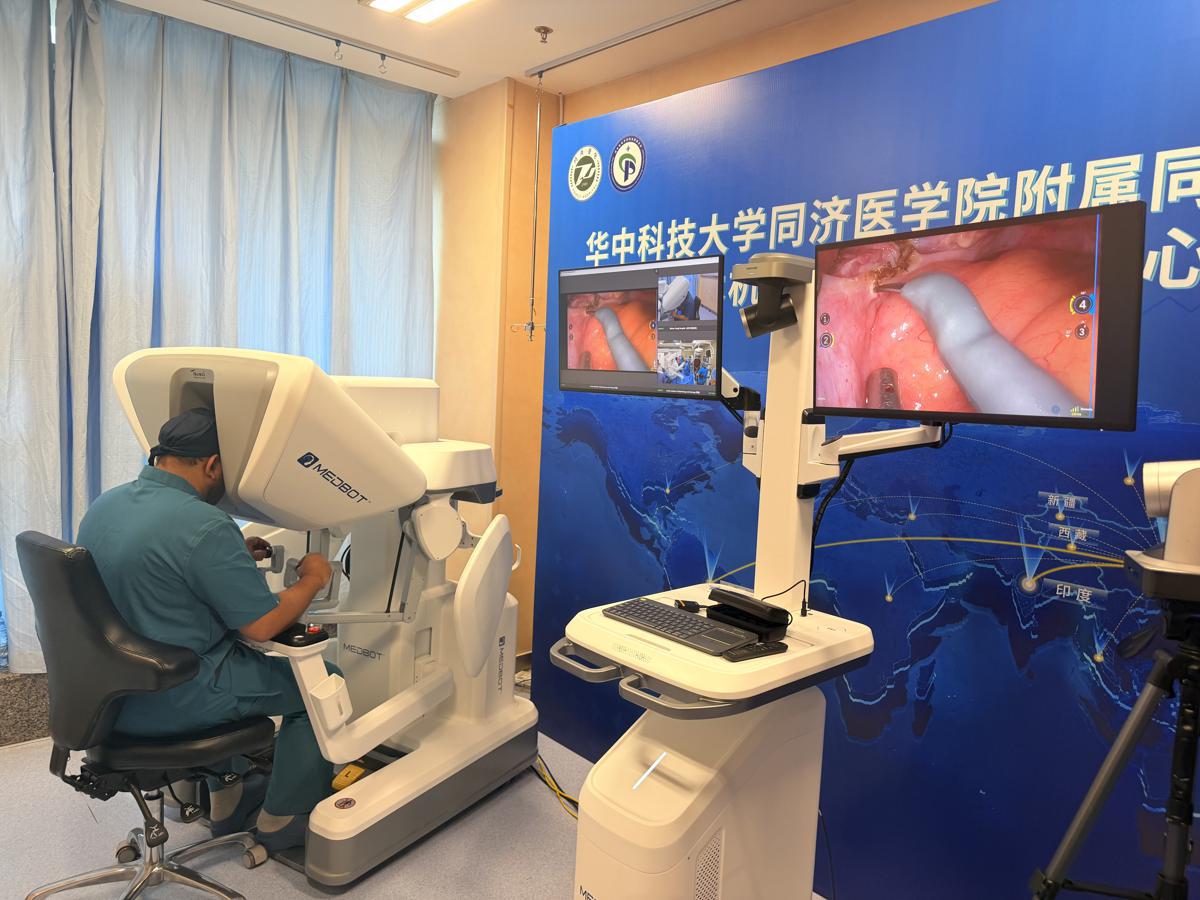
 On Monday afternoon, a doctor at Tongji Hospital in Wuhan, Hubei province, remotely conducted a robotic surgery on a patient in India, 3,000 kilometers away.
On Monday afternoon, a doctor at Tongji Hospital in Wuhan, Hubei province, remotely conducted a robotic surgery on a patient in India, 3,000 kilometers away.
Syed Mohammed Ghouse, a urologist from India, performed a bladder reconnection surgery within 90 minutes using technology developed in China.
The procedure relied on precise coordination among doctors, surgical robots, and network technology, according to the hospital, which is affiliated to the Tongji Medical College of the Huazhong University of Science and Technology.
First, Ghouse and the local medical team in India checked the patient's medical examination data online and worked out a surgery plan, including the movement route of a set of robotic arms.
Then, doctors and nurses in the operating room administered anesthesia to the patient and inserted the robotic arms into the patient's body. Fine surgical instruments and high-definition 3D cameras are fitted at the ends of the arms.
Seated at a console in Tongji Hospital, Ghouse observed real-time, magnified high-definition 3D images transmitted from the operating room through a binocular-style viewer, his hands working a set of controls that wouldn't look out of place in an old arcade. From this position, he guided the arms through the surgery. The robotic arms replicated the doctor's movements inside the patient's body. 5G transmitted the instructions within 200 milliseconds.
The local medical staff stood by in the operating room to take over the surgery in case of emergencies.
The operation was one of the 26 surgeries staged during the 10th Congress of the Chinese Chapter of the International Hepato-Pancreato-Biliary Association. Among them, five surgeries were connected live with foreign counterparts. Surgical experts from Brazil, Georgia, Greece, Uzbekistan, and India delivered remote surgical demonstrations covering hepatobiliary and pancreatic surgery, gastrointestinal surgery, urology, and other fields.
Chen Xiaoping, director of the surgery department at Tongji Hospital, is one of the initiators of this innovative model. He stated that a new technological revolution driven by AI, 5G and 6G communications, and robot technology is deeply integrating with the healthcare industry.
This model not only leads the global trend of medical technological transformation but also precisely aligns with the core goals of China's Healthy China 2030 initiative, which focuses on optimizing the distribution of medi
Editor: Zhilan Hu
