How long is the history of Wuhan? From July 18 to 20, the tour group studying the roots of Wuhan visited Panlongcheng, where the city of Wuhan originated 3,500 years ago. The tour was a part of the event themed "Understanding China from the Yangtze River: a tour of Hubei Province." Students from two local primary schools joined the tour.
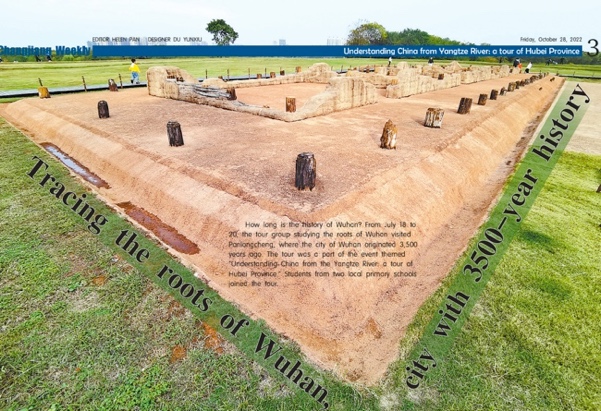
The Panlongcheng Site
The Panlongcheng site, hailed as the birthplace of Wuhan, is the center of early bronze civilization in the Yangtze River basin area. Covering an area of 3.95 square kilometers, it was selected in 2021 as one of the "Top 100 Archaeological Discoveries in China."
The group first visited the Panlongcheng Site Museum, where a large number of precious cultural relics unearthed from the site over the last 60 years were displayed. These relics include various stone tools, pieces of pottery, and bronze artifacts made during the Shang dynasty.
The Grand Round Bronze Cauldron amazed Zhang Yiheng, Zhang Yanxin, and Tang Mingchen. The three are pupils from Shuiguohu No. 2 Primary School. Seeing the cauldron, they exclaimed, "So huge! It may be taller than me," "The carving on it is so exquisite that it is hard to distinguish whether it is a picture or a text!"
Chen Shuxiang was the group's counselor. As a research fellow working with the Hubei Provincial Institute of Cultural Relics and Archaeology, he gave professional explanations to the children — the cauldron is the treasure of treasures in the museum; it is 85 cm high and 55 cm in diameter, the largest one of its kind made during the Shang dynasty.
Chen said hundreds of bronzes have been unearthed in Panlongcheng so far, marking the largest number among the archaeological sites of that period in China. The discovery verifies that the Yangtze River and the Yellow River are both cradles of Chinese civilization.
"Bronze smelting and casting are to the social, economic, and technological development of that time, what chip manufacturing is to a nation's development today. The relics show that the ancestors of Panlongcheng mastered the core technology of smelting and casting as early as 3,500 years ago, pushing forward the development of the Yangtze River civilization," said Chen.
After visiting the exhibits, the group came to an excavation area on the north slope of Yangjiawan in the Panlongcheng National Archaeological Site Park to experience and explore the excavation.
Liu Yunsong, a doctoral candidate from the Department of Archaeology of Wuhan University, served as an expositor to the pupils.
"With the principle of giving priority to protection, the vast majority of the Panlongcheng sites have not been excavated. As a result, the actual area excavated may be less than two percent," said Liu. His words aroused surprise and excitement from the students.
Cao Changze, a pupil from Guanggu No.1 Primary School, was accompanied on the tour by his grandfather, who said "whenever my grandson sees these cultural relics or hears the explanations, he shares with me his feelings and ideas. It is really a valuable opportunity for kids to learn from the experts face to face."
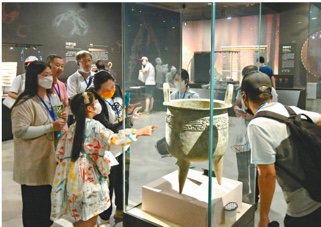
Appreciating relics at the Panlongcheng Site Museum
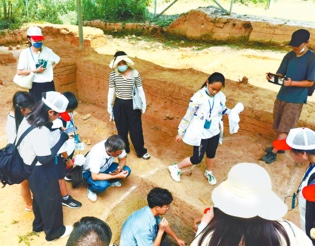
Visiting the excavation area
